


At the 12th PRCM Regional Marine and Coastal Forum (FOMACO, in French) in Nouakchott, the REDUCE Project and UNESCO-IOC’s MSPglobal Programme convened an interactive round table on marine spatial planning in West Africa, linking bycatch reduction, sustainable fisheries, biodiversity conservation, inclusive ocean governance and regional cooperation under the Forum’s blue economy theme.
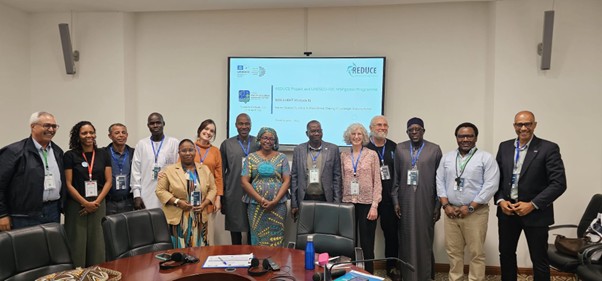
Ocean health depends on continued strengthened collaboration and on how spatial decisions are made across shared seas. That message framed the side event “Marine Spatial Planning in West Africa: Sharing Knowledge, Sharing Action”, co-organised by the REDUCE Project and the MSPglobal Programme on 29 April 2026 during the 12th PRCM Regional Marine and Coastal Forum in Nouakchott, Mauritania. Bringing together national and regional experts, the round table explored how marine spatial planning (MSP) can connect biodiversity conservation, sustainable fisheries, bycatch reduction and inclusive blue economie development.
Shared ocean space, shared priorities
The MSP side event took place within FOMACO 2026, convened by the Regional Partnership for the Conservation of the Coastal and Marine Zone in West Africa (PRCM) under the theme “Ocean health: the lever for a sustainable and inclusive blue economy”. The forum provided an important regional platform for discussing integrated governance, sustainable fisheries, biodiversity conservation, innovative financing and cooperation across West Africa. Within this agenda, the side event positioned MSP not as a technical exercise alone, but as a participatory governance process for balancing ocean uses, reducing pressure on marine ecosystems and supporting coastal livelihoods.
Connecting REDUCE and MSPglobal: The milestone collaboration
The REDUCE–MSPglobal collaboration brought together two complementary perspectives. REDUCE contributes evidence (tracking data) and decision support tools to reduce bycatch of threatened marine megafauna such as sea turtles and supports sustainable fisheries management in the Eastern Central Atlantic. MSPglobal contributes international guidance, capacity development and practical approaches for ecosystem-based, biodiversity inclusive, climate-smart, cross-sectoral and transboundary marine spatial planning. Together, the initiatives showed how bycatch risk information, stakeholder knowledge and spatial planning can inform decisions that are more precise, inclusive and feasible.
From evidence to action
Opening remarks introduced REDUCE objectives and results, MSPglobal tools and supporting materials, and opportunities related to funding and data sharing. The discussion underlined that effective MSP depends on strong partnerships and bridging science and policy: data must be accessible, usable and trusted by the institutions and communities expected to act on it.
REDUCE presented its work to identify bycatch hotspots for threatened marine megafauna, including sea turtles, and to develop decision-support approaches that can guide spatial and temporal management measures. This provided a clear example of how scientific evidence can support targeted action, helping managers protect vulnerable species while reducing unnecessary impacts on fishing activity.
MSPglobal presented its activities at global, regional and national levels. At global level, guides and good practices documents have been developed for several topics including biodiversity inclusive MSP, climate-smart MSP, engaging offshore wind energy in MSP, etc. Also, self-paced online trainings are made available on the OTGA platform. At regional level, MSPglobal is facilitating the development of a regional MSProadmap by experts of the recently established MSP Technical Expert Group for the Atlantic Coast of Africa (MSP-TEG-ACA) under the lead of the Abidjan Convention and IOCAFRICA Secretariats. At national level, the Programme has been devoted to support national in-person trainings and implementation of the MSPglobal Rapid Assessment Methodology (RAM).
Putting cooperation into practice
Practical experiences from Côte d’Ivoire and Benin grounded the MSP discussions. For Côte d’Ivoire, the Grand-Bassam experience, building on outputs of the implemented RAM, highlighted progress towards a management plan while pointing to challenges around governance, financing, institutional mandates and shared data. For Benin, participants heard about a 10-stage MSP process with support of a past MSP initiative (namely MAMI WATA) that drove the creation of two marine protected areas in Donaten and Bouche du Roy; the support of MSPglobal with national training and implementation of the RAM was also highlighted. A key lesson was the value of combining scientific data with Stakeholders Ecological Knowledge (SEK) to ensure local buy-in: build legitimacy, improve accuracy and strengthen local ownership.
The interactive session invited participants to identify shared challenges, opportunities for regional cooperation and priority actions for MSP in West Africa. Data, knowledge and decision support emerged as the top priorities, followed by stronger governance and cooperation. Participants also highlighted barriers including limited data access and availability, weak capacity to translate raw data into planning decisions, control deficits, un-enforceable laws and collisions among sectoral policies.
Next steps for West Africa
The MSP side event closed with a clear direction: Call for continued collaboration. MSP in West Africa will require stronger institutional coordination, sustained capacity development, inclusive stakeholder engagement, regional data-sharing and financing that can move planning from dialogue to implementation. By linking bycatch reduction, sustainable fisheries, biodiversity conservation and inclusive governance, the round table contributed directly to the Forum’s central message. Moreover, the key findings will be shared with the MSP-TEG-ACA as a source of information to the regional MSProadmap under development. A sustainable blue economy in West Africa depends on healthy marine ecosystems—and on the shared plans, partnerships and evidence needed to protect them.
DOCUMENTS:
RELATED LINKS:
- REDUCE Project: Protecting Marine Biodiversity for a Sustainable Future
- MSPglobal International Guide on Marine/Maritime Spatial Planning Volume 2 – Biodiversity Inclusive Principle
- MSPglobal International Guide on Marine/ Maritime Spatial Planning Volume 3 – Climate-smart Principle
- MSPglobal Rapid Assessment Methodology
CONTACT:
MSPglobal.comm@unesco.org