


On 9 September 2024, MSPglobal 2.0 hosted a webinar highlighting recent Marine Spatial Planning (MSP) publications. The first part of the webinar focused on MSP publications regarding Indigenous Peoples and local communities (IPLCs), whereas the second part centred on MSP publications about gender and poverty. The UNESCO-IOC and its Sub Commission for Africa & the Adjacent Island States (IOCAFRICA) facilitated the event alongside UNESCO’s Local and Indigenous Knowledge Systems programme (LINKS) and the Swedish Agency for Marine and Water Management (SwAM). The webinar was attended by about 280 viewers from 100 countries.
MSPglobal 2.0 kicked off its webinar series with a first edition focusing on boosting human rights-based approaches and social wellbeing in MSP. The goal was to have a dialogue about recent MSP publications* by the co-organizers UNESCO-IOC, UNESCO-LINKS and SwAM which focus on the engagement of Indigenous Peoples and local communities (IPLCs) in MSP, as well as on MSP in the context of poverty and gender.
Indigenous Peoples and local communities
The first block of the webinar was dedicated to the two publications by UNESCO-IOC and UNESCO-LINKS on engaging IPLCs, and Embracing Indigenous and Local Knowledge (ILK) in MSP. The lead author Fernanda Terra Stori presented Volume 1 which discusses basic concepts, as well as Volume 2 which suggests good practices. The latter publication on good practices was a collaborative effort based on several participatory meetings with representatives of research groups, MSP practitioners, governmental authorities and a mix of Indigenous groups with experience in ocean management.


In order to illustrate the good practices, some of the contributors of these publications shared a video message which is available on our YouTube channel together with the full webinar recordings in English, Spanish and French.
To round up the block on IPLCs, three case studies were also presented showcasing the relevance of ILK when planning and managing the ocean space and its resources. First, Johnson Jament from the BlueGreen and Coastal Resource Centre in India shared how the ILK of Mukkuvar people is used to manage their customary marine spaces in Kerala. Next, Pascal Thoya from the Kenya Marine Fisheries Research Institute illustrated a co-management structure used in Kenya as an example of including local communities in marine resource governance. Lastly, Vivienne Solis Rivera from CoopeSoliDar presented a case study from Costa Rica about the participation of small-scale fisheries in MSP.
Poverty and gender
The second block of the webinar started with a concise keynote by Ingela Isaksson from SwAM about addressing poverty and gender in MSP. Iskasson suggested MSP practitioners make use of the new step-by-step guide which will help create an inclusive process and a socially sustainable MSP.

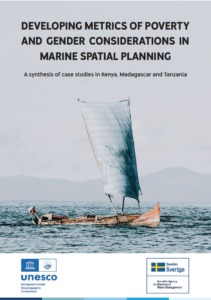
Moreover, she also introduced case studies and the conclusion of those put together in a publication on how to develop metrics of poverty and gender considerations in MSP.
To conclude the last block, Prof Richard Mulwa from the University of Nairobi dived deeper into the case studies mentioned above on poverty and gender. These were conducted in three coastal areas of Kenya, Tanzania, and Madagascar. Prof Mulwa described how the studies were performed, and which metrics one can use to measure the four indicators: 1) resources 2) opportunity and choice 3) power and voice 4) security.


Finally, the webinar was drawn to a close with a lively Q&A moderated by Gabriela Factor (Danish Institute of Human Rights) which again raised important aspects. Final words also expressed a call to action for MSP authorities and practitioners to create a truly inclusive process that takes into account the connection between IPLCs and the ocean, their livelihoods and social wellbeing.
Let’s strive together towards a sustainable and equitable blue economy, where no one is left behind, where gender equality exists as well as respect for diversity and inclusivity, and where people get out of poverty.
*PUBLICATIONS:
- Engaging Indigenous Peoples and Local Communities, and Embracing Indigenous and Local Knowledge in Marine Spatial Planning. Volume 1 – Basic Concepts (UNESCO-IOC and UNESCO-LINKS, 2024)
- Engaging Indigenous Peoples and Local Communities, and Embracing Indigenous and Local Knowledge in Marine Spatial Planning. Volume 2 – Good Practices (UNESCO-IOC and UNESCO-LINKS, 2024)
- Developing Metrics of Poverty and Gender Considerations in Marine Spatial Planning (UNESCO-IOC and SwAM, 2024)
- Poverty and Gender Perspectives in Marine Spatial Planning: Lessons from Kwale County in Coastal Kenya (UNESCO-IOC and SwAM, 2024)
- Incorporating poverty and gender considerations in Marine Spatial Planning: Pilot baseline study of the Sofia and Boeny Regions, Madagascar (Turpie et al., 2022a)
- Incorporating poverty and gender considerations in Marine Spatial Planning: Case study of the Tanga region in Tanzania (Turpie et al., 2022b)
- Poverty and gender considerations in marine spatial planning – Conceptual and analytical framework (SwAM, 2022)
- Guide: Address poverty and gender in marine spatial planning (SwAM, 2024)
DOCUMENTS:
RECORDINGS:
CONTACT: