


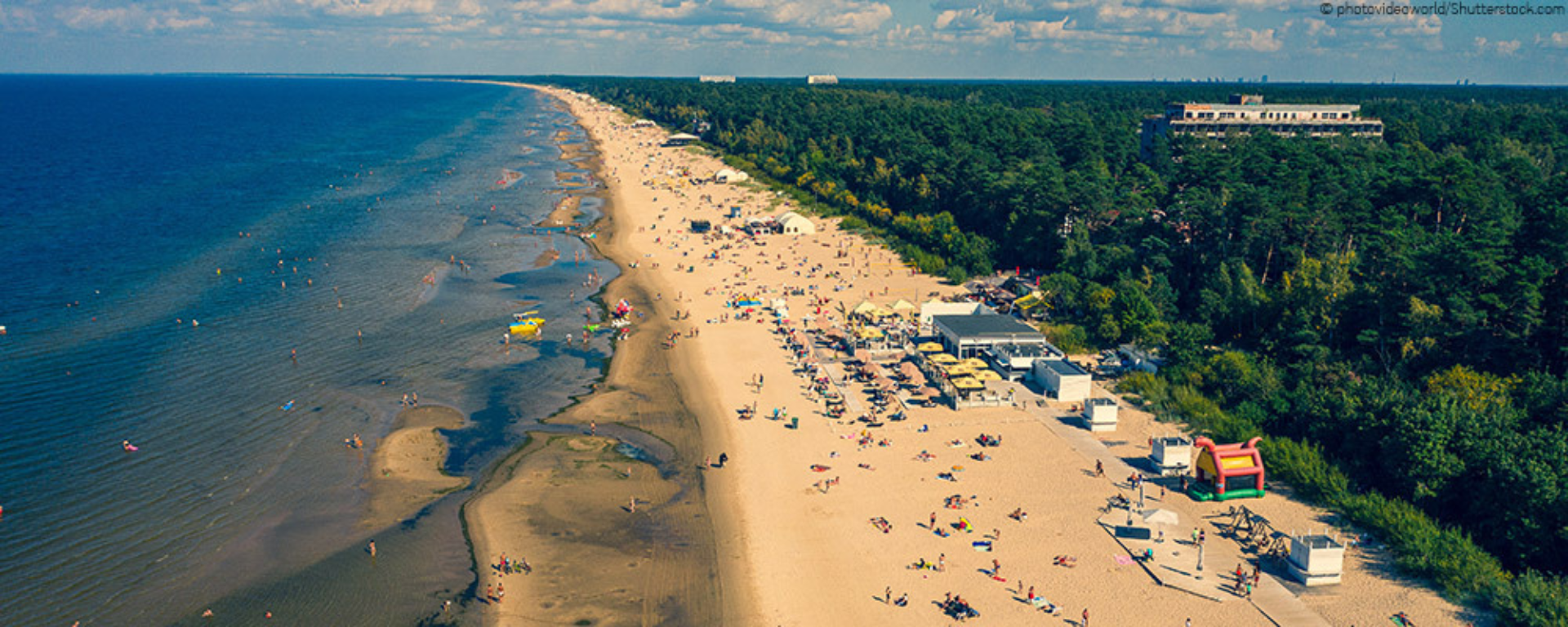
Country information
Basic facts on marine waters
- Territorial Sea (12 NM): 10 178 km2
- Exclusive Economic Zone: 17 656 km2
Technical resources related to MSP
- MSP Annex 1. Uses of the Sea
- MSP Annex 2.Criteria for defining priority uses of the marine space
- MSP Annex 3. Interests of the neighboring states in the marine space
- Environmental assessment
- The ecosystem-based approach in MSP – The Latvian recipe
- Stakeholder consultation in the Latvian MSP process
- Towards coherent cross-border Maritime Spatial Planning in the Central Baltic Sea
- Determining permitted sea uses
- Pilot MSP for the western coast of Latvia
- Strategic scenarios for the use of the sea
- The Interim Assessment of the Maritime Spatial Plan for Internal Waters, Territorial Waters and the Exclusive Economic Zone of the Republic of Latvia
- Maritime and Coastal Data Tool (in development and to be launched in Spring 2025)
- Territorial Development Planning Information System
Relevant MSP projects
- Capacity4MSP (2019-2022)
- Land-Sea-Act (2019-2021)
- Pan Baltic Scope (2018-2019)
- Baltic LINes – Coherent Linear Infrastructures in Baltic Maritime Spatial Plans (2016-2019)
- Baltic SCOPE (2015-2017)
- PartiSEApate – Multi-Level Governance in MSP throughout the Baltic Sea region (2012-2014)
- BaltSeaPlan – Introducing Maritime Spatial Planning in the Baltic Sea (2007-2013)
- MSP-GREEN
- SELINA
- Baltic Sea2Land
Current status of MSP
Name of the plan |
Maritime Spatial Plan for Internal Waters, Territorial Waters and the Exclusive Economic Zone of the Republic of Latvia |
|---|---|
Year of approval
|
2019 |
Size of planning area in km2
|
27 834 km² |
Authority leading the MSP process
|
Ministry of Smart Administration and Regional Development |
Current status |
|
|---|---|
Pre-planning
|
Completed |
Assessments for planning
|
Completed |
Plan development
|
Completed |
Plan completion
|
Completed |
Plan approval
|
Completed |
Plan implementation
|
Underway |
Plan review
|
Underway |
MSP Typology |
|
|---|---|
Scale (1 = Local / 2 = Sub-national / 3 = National)
|
National |
Scope (1 = Coastal Zone / 2 = Coastal and Marine / 3 = Marine)
|
Marine |
Purpose (1 = Strategic / 2 = Zoning / 3 = Comprehensive)
|
Zoning |
Political commitment (1 = Informal / 2 = Executive decision / 3= Legal statute)
|
Legal statute |
Implementation framework (1 = Guiding / 2 = Legally binding)
|
Legally binding |
Main objectives (1 = Biodiversity conservation / 2 = Economic development / 3 = Multiple objectives)
|
Multiple objectives |
Spatial allocation (1 = Limited / 2 = Partial allocation / 3 =Detailed allocation)
|
Partial allocation |
Stakeholders involved (1 = Limited / 2 = Key sectors / 3 =Sectors & Public)
|
Sectors & Public |
Participatory process (1 = Informative / 2 = Consultative / 3 =Collaborative)
|
Consultative |
Funding (1= Government / 2 = Public-Private / 3 = Grants)
|
Grants |
National authority in charge of MSP |
Ministry of Smart Administration and Regional Development |
Governmental funding |
N/A |
External funding |
N/A |
Public-private funding |
N/A |
Total size of planning area |
27 834 km² |
Time required to complete the planning document |
The planning document has been completed and is being implemented, the drafting process was initiated in 2014 and spanned 5 years until official approval in 2019 |
Main issues that led to the adoption of MSP (drivers) |
Conflicting interests between sectors such as environmental protection, energy production, fisheries, shipping, tourism and heritage protection |
Stakeholder engagement activities |
Each iteration of the Plan draft went through a phase of stakeholder engagement – suggestions and corrections were made by various institutions and organizations. Each comment was then reviewed in due process. |
Sectors included in planning |
Transport, nature protection, defence, energy, foreign affairs, health, local and regional governance |
Articulation between MSP and Integrated Coastal Zone Management (IZCM) |
MSP touches on the interaction between land and sea as many maritime functions require terrestrial infrastructure/logistics etc. |
Articulation between MSP and marine conservation(including the Kunmig-Montreal Global Biodiversity Framework) |
Marine conservation explicitly considered in the original MSP, additionally, the Interim Assessment addresses the Kunmig-Montreal Global Biodiversity Framework directly. |
Articulation between MSP and sustainable blue economy |
References to and goal-setting for Blue Growth, however, the understanding of the difference between Blue Economy and Blue Growth has since been strengthened and focus is shifting to Sustainable Blue Economy |
Articulation between MSP and climate change (including the Paris Agreement) |
The MSP and the Interim Assessment both address climate change (including the Paris Agreement) and its implications directly considering the environmental state of the Baltic Sea, as well as future projections. |
Plan approval process |
The MSP is drafted and prepared by the ministry responsible for spatial planning, after the MSP has gone through the formal planning processes (drafting, environmental assessment, stakeholder engagement), once finalized, the MSP is approved by the Cabinet of Ministers |
Legal status of the plan (guiding or legally binding) |
Legally binding |
Plan review process |
The Ministry of Smart Administration and Regional Development has completed 1 interim assessment of the MSP (2023) and another is set to take place before 30 December 2029. Several points of adjustment were identified and the process of MSP update is set to be initiated in 2025. |
Performance monitoring and evaluation |
The Ministry of Smart Administration and Regional Development has completed 1 interim assessment of the MSP (2023), and another is set to take place before 30 December 2029. |
Interactions with neighboring countries in the context of MSP attending transboundary coherence approaches |
The Ministry of Smart Administration and Regional Development collaborates with multiple Baltic Sea Region countries in the VASAB and HELCOM-VASAB cooperations. This includes both formal interactions, as well as co-creation of new MSP and coastal planning projects, which ensure regular experience exchange, building on the region’s knowledge as well as close communication over the duration of plan drafting, implementation and updates. |
Legal framework
MSP is regulated first and foremost by the Spatial Development Planning Law and Marine Environment Protection and Management Law, however, other legislation provides basis for the Plan – regulations and laws concerning building at sea, shipping and transport at sea, fishing, use of protected areas, energy sector licensing etc. A full list of laws and regulations stipulating MSP and marine processes can be found here under “Related documents” – “Other related documents”.
Legislative processes necessary to begin the development of several offshore wind parks are also in the process – for OWP “Rietumi” and Estonian-Latvian project ELWIND. Additionally, a new bill to reduce barriers to development of wind parks “Law on Simplified Procedures for the Construction of Wind Power Plants for Promotion of Energy Security and Independence” (unofficial translation) has been approved by the Cabinet of Ministers and is to proceed to Saeima.
For renewable energy production at sea (as well as on land), a new Law on the Facilitated Procedures for the Construction of the Energy Supply Buildings Required for the Promotion of Energy Security and Autonomy came into force in 2022.
Contact
Ministry of Smart Administration and Regional Development
Kristīne Kedo – Unit Head of the Spatial Planning Policy Unit